
Fathom Unplugged: Meet the Developers behind the Deep Sea Adventure
Written by K. Lambert, C. Kingsnorth and M. Law - Jun 23 2025
Paper Fort Games are an independent tabletop game studio based in Nottingham, UK. Their first game; Cosmoctopus was released through Kickstarter in 2022, followed by Terraria in 2024. With a passion for accessible games that encourage storytelling, co-operative play, and friendly competition, the team at Paper Fort Games are looking forward to launching their newest game Fathom this summer.
In our second instalment of interviews with the team, we are speaking to Chris Kingsnorth and Matt Law about the development of Fathom.
Hi Chris and and Matt! We really enjoyed our previous chat with Fathom’s Game Designer Dan Helfer. It was great hearing about the journey of Fathom; from his initial idea - through to signing with Paper Fort games. When was the first time the Paper Fort team encountered Dan and his concept for Fathom?
Both: We really enjoyed the interview with Dan - there were some pictures we hadn’t seen before of early prototypes! Thanks for arranging it.
Chris: I met Dan at UKGE 2022 - he played Cosmocotopus and afterwards gave me a sell sheet for Fathom (then called ‘Life at Depth’). The sell sheet was clear and eye-catching - the concept of the game intrigued me, so I arranged a virtual demo via Tabletop Simulator.
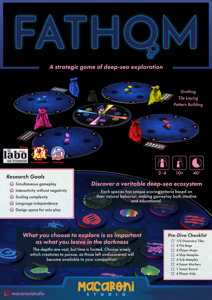
Fathom Sell Sheet Image
There must be so many great game ideas floating around in the universe and not many of them make it through to publication. What was it about Fathom that made you think “This game needs to be published?” We would be curious to know if there was something in particular that made you really excited to bring Fathom into the Paper Fort family?
Chris: Firstly, it was the way Dan approached us. He took the time to play another of our games, his sell sheet and pitch were brief and clear, and he was confident without being arrogant. As much as we are about games, we also want to work with people who we get on well with, and who are invested in the games that they design. As for the game itself, the element of simultaneous play, the table presence of the components and the sonar board mechanic were what really got me excited about the design. The fact that it is super fun, plays in 45 minutes and supports up to 4 players is what sealed the deal for me.
Could you share any of the key stages or challenges that were involved when developing Fathom? Is there a standardised journey each game has when Paper Fort Games takes it on, or is each games journey completely unique from start to finish?
Chris: There are some standardised ‘checkpoints’ that a game has to pass through during development, but the exact route is different for each game. We also try to learn from previous development journeys, and adapt our approach based on those lessons. Once a game is signed, the first stage is for the development team to familiarise themselves as much as possible with the game before we start making changes - this allows us to identify the areas that we feel need most attention during the development process. Next, it’s playtesting, playtesting, playtesting - getting the game out in front of as many people as possible. Every 2 weeks, we’d review the playtesting data and feedback, then implement changes to be tested over the next fortnight. Via this process, we make small but important changes to the game that keep the original vision intact while adding a final layer of polish to the gameplay. Once we’re happy that the game is achieving what we want, and that playtesting feedback is consistently good, we move on to art, graphic design and rulebook writing (which all need to be tested with players too). The final step is blind playtesting, where groups are given the game and the rulebook and are asked to play the game without help from us. This tests the game as a whole package - mechanisms, visual and rulebook.
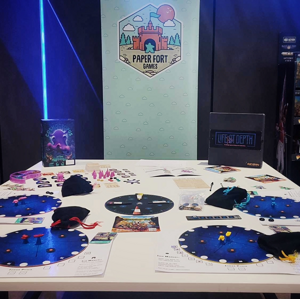
Playtesting at Confetti Nottingham
We can imagine that bringing the initial concept of a game to life can be quite difficult. The manufacturing process must be quite an intense one! Could you share with us a little more about the production process involved with a game like Fathom?
Chris: Of course! Once we know roughly what the final components of a game will be, we reach out to various manufacturing partners for initial quotes. We have to make decisions on the material, thickness and other attributes of every game piece - it’s always a challenge to balance quality of components against the price we want the game to retail for. For example, in Fathom, we would have loved to make wooden or acrylic discovery tiles, but each of them is unique and the cost would have been prohibitive to include in a game that we want to sell for under £30. Instead, we went for a super-chunky punchboard - still satisfying to use and great quality, while keeping the game at a reasonable price for gamers. We also made sure that the game's tile bags are comfortable to use, big enough for actual human hands and are beautifully screenprinted so the game feels ‘deluxe’, but without the deluxe price tag. Before printing the games, we receive ‘white samples’ that are blank versions of each of the components; this lets us check the quality of materials before we commit to printing thousands of copies. This is also an opportunity to check the tactility of the game; for me, the way a game feels to unbox and play with is as important as how it plays. The process from initial quote to final manufacturing takes many months, but the effort is worth it to get everything just right.
Dan mentioned using the Discord Server Virtual Play test (VPT) during his initial development of the game, and how it helped him to refine Fathom. Is there an ‘in house’ method of play testing games at Paper Fort games? We would also be curious to know where you play test the games, is it all done in house or do you have a separate space dedicated to play testing?
Chris: We use a blend of in-house playtesting (i.e. the Paper Fort Team playing together at the office), online playtests with fans of our previous games and in-person playtesting. We’re very lucky to have three higher education institutions in Nottingham, so we often attend student events and playtest there. In addition, I am the organiser of Break My Game Nottingham, a free in-person playtesting event that has been running monthly for the past 3 years. This is a great place to try our games with other designers and members of the public, who provide a diverse mix of viewpoints that results in invaluable feedback.
Break My Game Nottingham
When we spoke to Dan, he mentioned that the “original design was much darker, focused on exploring the deepest depths of the ocean with an effort to maintain some scientific realism. The Paper Fort Games team preferred a more whimsical treatment to fit with their other games and came up with the concept of Fathom Island and the legacy of Nautilus Leclerc.” What made you decide on these changes for the board game? Has anything else changed since then?
Matt: When I first came on board with the project, the concept art and style was something closer to ‘The Abyss’ movie (89, give it a watch, it still holds up) as to where it is now. I really enjoyed the look but it didn’t feel like the right representation for the weight of gameplay. At the time I was playing a lot of The Flame in the Flood and Subnautica video games and they were an influence on the style we went for (I’d say Cloudy with a Chance of Meatballs for worldbuilding too). Once we found Kat’s artwork it felt like what we had envisioned in our development meetings. I’d say the other big changes were the playerboards. Both Chris and I really wanted them to feel like you were operating the mechanical side of the ships and submarines - I think that really comes across as you play.
Fathom has an appealing deep sea concept for players to explore. We would love it if you could share a bit more about these themes with us, and in particular what drew you to the themes?
Chris: Nature is a theme that will never go out of fashion. Games provide an opportunity for people interested in themes to indulge their passion, but also an opportunity to introduce gamers to new areas of interest - in Fathom, though set around a fictional island, the creatures are all real, the game’s mechanics are based on their real-world behaviours, and we provide some interesting facts about each species. For example, did you know that below 4500 metres, sea cucumbers can make up 90 percent of life on the seafloor? Incredible. I definitely didn’t know that before developing this game!
Matt: That’s a great question. I was really intrigued with how the pattern and point scoring mechanics mirror and replicate the biodiversity of the ocean. It was always a good foundation for the development to be anchored to. For example, we knew we wanted sharks in the game but didn’t know what would be the counterbalance. This led to some research and the discovery of finless soles, which secretes a substance that includes Pardaxin, an irritant to large predators such as sharks. These are just some of the weird and wild facts you can learn whilst playing this game.
Now that the game is near to being released, do you have any favourite components that you would like to share with our readers? What was it that made those components stand out to you?
Chris: For me, it’s the player consoles. These sit below your ocean board and as well as featuring team-specific thematic art, they are used to track your turns. We wanted the process of moving along these turn tracker to be fun, so they have a tactile ‘gearstick’ vibe which I really enjoy.
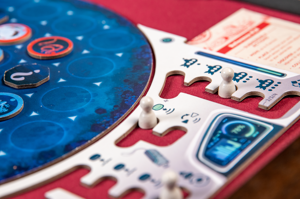
Player Console
Matt: The player consoles are up there for me too. Whilst not quite a component, I love the layout of the rulebook with its fold-out pages for the expeditions. I enjoy the air of mystery but also the amount of art it allowed us to fit in!
The Paper Fort stand was constantly busy at the UK Game Expo, and from an outsiders perspective it seemed to be a really popular stand for would-be players. How do you feel Fathom was received at the Expo?
Chris: We were blown away by the reception; we had lots of attendees who made a beeline for our stand just to check out the game because they had seen it on preview lists. Our 3 demo tables were full from open to close on every day of the convention and the majority of players who tried the game went on to preorder it - a testament to Dan’s design and the appeal of the theming.
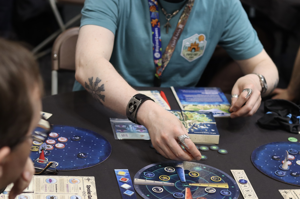
Fathom at UKGE, 2025
There is definitely a lot of hype surrounding the release of Fathom, it has been featured on a lot of ‘ones to watch’ lists, and we can safely say that the Chaos Cards team are excited for it’s impending release. Do you think there is the possibility for any Fathom expansions? Are you already thinking about what games are on the horizon for Paper Fort games?
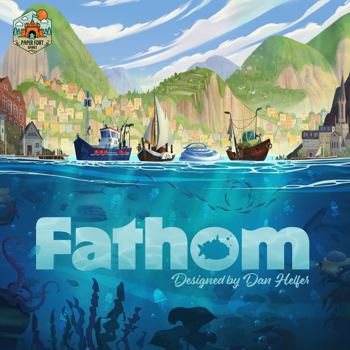
Chris: The ‘Expedition’ system (the way that different tilesets are stored in separate themed tuckboxes) means that we can easily release small Expedition expansions for the game - we’ve already got ideas for these, and I’ve always loved the idea of exploring what marine biology might look like on another planet where water has been found. If you look closely at the cover, you’ll see an observatory nestled in the hills above Fathom - maybe the teams already have the technology to explore marine life on other worlds… Speaking of the oceans and space, our expansion to engine-building, tentacle gathering game Cosmoctopus will be heading to crowdfunding later this year, featuring a new cosmic cephalopod - Prismoctopus!
That sounds amazing! Thanks for taking the time to answer our questions. We have one last question for you before we go. If you could invite anyone throughout history (dead or alive) to play Fathom with you, who would you choose and why?
Matt: I enjoy the idea that though we invite this person, perhaps they may decline. I’m going to say Sam Reich from Dropout. I think he’d be a hoot to hang out with and hopefully he’d enjoy it - plus I could tell him all my gamechanger ideas.
Chris: Thanks for having us! For me, it would have to be Sir David Attenborough. He narrated The Blue Planet, a documentary about our planet’s oceans that was one of my favourite programs to watch as a child, which feels appropriate!
Thank you so much to Chris and Matt for taking the time to do the interview and providing such entertaining answers. Keep an eye on our News and Events page for future interviews with the team at Paper Fort games. The Chaos Cards team are definitely learning a lot about the hard work that goes into a Board Game being created. Next up, we will be talking to the Artist behind the beautiful art work that makes up the Fathom boardgame.
We can't wait to share the upcoming interviews with you all. What do you think of Fathom? Will you be trying this one out?