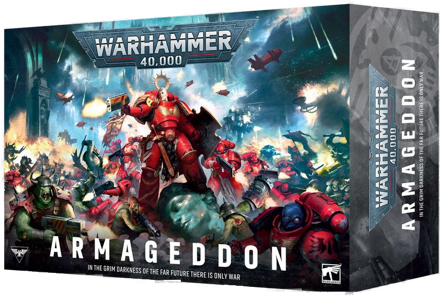

Check Out Warhammer 40k 11th Edition with Voidstorm Games
Written by J. Denton and K. Lambert - Jul 06 2026
Did you know that at Chaos Cards we often sponsor local gaming events? That’s why we are thrilled to be working with Voidstorm Games, a group known for running epic wargaming events and printing top-tier 3D terrain. (Want to know more about them? Check out their previous guest post with us!)
With the recent launch of Warhammer 40k 11th Edition taking the miniatures community by storm, learning a new set of rules can certainly be a minefield. Luckily, James from Voidstorm Games has written us a handy guide to run through the biggest updates and how they'll impact the game going forward.
Change is on the way.

Starting from 20th June, Warhammer 40k is updating to the latest edition (11th Edition). For those of you that don’t know, since around 8th edition Games Workshop have entered a roughly 3 year edition cycle. These include rule updates and often sweeping changes.
This helps keep the game feeling new and fresh, as well as allowing them to address concerns from the previous edition or introduce entirely new concepts that wouldn’t work with the previous rule set.
Importantly, 11th edition is one where the codexes from 10th edition are still functional, but with FAQs to allow units and their rules to function in the new edition.
A focus on Narrative & immersion
Games Workshop have aimed for a greater focus on narrative and immersion with this edition. The biggest shift is the terrain (even in competitive games) where there is in theory much more freedom to what is placed on the table.
With a core system of terrain types which keeps things straight forward and simple for players. In 11th edition you can now place the Terrain Footprints (pieces of card, acrylic or neoprene area templates) that mark out a terrain space. This then governs how it functions regardless of what is placed on top.
This core system allows for players to have freedom to place whatever they want; whether that be trees, pipes, barricades statues or other weird and wonderful alien structures.
Another very noticeable change is that these terrain footprints are now the objectives. Gone are the frisbee-like circular discs that our tiny toy soldiers defended – the reasoning behind this is to make it feel more immersive.

There are a whole host of rule changes that we won’t go through in detail, but here are a few of the major shifts that James believes will impact the game in a meaningful way:
Terrain as Objectives: Having the terrain itself act as the objective makes for a much more engaging game. Units are no longer just hiding behind walls on random circles.
The "Fly": The way Fly works has completely changed. Units now just take a flat 2” movement tax to move over ruins and models. No more calculating complex angles or engaging in casual tabletop Pythagoras.
Charging from Deep Strike: Charging is now strictly measured from base to base. This is highly impactful when you consider that units coming in from reserve (now universally called Ingress) arrive 8” away. Because they must be 8.1” away from their target, it remains a 9” charge.
Scarier Melta Weapons: Melta rules now trigger when ingressing, provided the weapon range is at least 18”.
Transports & Abilities: Abilities now work from inside transports—units no longer vanish into some strange warp void. For example, you can use abilities like Malys’ redeploy even while she is embarked. This is a fantastic change, only restricted if a rule explicitly requires a unit to be physically on the battlefield or specifies a range.
A 2” Engagement Range: This 2” shift impacts multiple areas of play:
No more wall-hugging: You can no longer stand 1” away from a wall to stay safe from a charge. Finally!
Faster combats: Getting models into combat is much easier, saving you from spending an agonizing amount of time micro-managing pile-ins.
Spacing: You can’t get quite as physically close to enemy units as before.
The Dreaded Snake Eyes: Rolling a double 1 to charge (excluding modifiers) is now an automatic failure.
Streamlined Activations: Pile-ins and consolidations have been cleaned up significantly. The active player now completes all of their pile-ins first, followed by the opponent, with the same structure applied to consolidations. This makes the phase much more efficient.
The Biggest Shift: Force Dispositions
Perhaps the most massive change to the game is how missions operate. There are now 5 Force Dispositions that dictate the style of mission you play:
Take and Hold: Perfect if you want to stand stalwart on objectives and push back enemy attacks.
Purge the Foe: The go-to if your goal is simply to eradicate all enemy forces.
Reconnaissance: Designed for sneakily gathering data and intel while actively avoiding engagement.
These asymmetrical missions make for a very different playstyle, which we think is great. It gives the design team more levers to pull, making the game much easier to balance.
We are all really excited for Warhammer 40k 11th Edition, which is officially out now! At the time of writing, all core rules, points, and the brand-new app are live on the Warhammer Community website.
Boosting the Kent Miniatures Scene with Voidstorm Games and Chaos Cards

We are thrilled to be working alongside Voidstorm Games to help grow the gaming scene here in Kent. Between their professionally run tournaments and high-quality 3D printing services, they are a massive asset to the gaming community in Kent. Many thanks to James for taking the time to go through the new updates with the Chaos Cards team.
Don't forget to grab your supplies from us at Chaos Cards before you head out to battle with Voidstorm Games! We don’t just stock Warhammer, we have a range of board games, card games and accessories to suit everyone's interests.
What are your thoughts on the Warhammer 40k: 11th Edition? Let us know over on our socials, would be great to hear from you!